
The Yen Intervention a Global Effect
The Japanese yen is one of the most important and influential currencies in the global financial system. The currency has been on a prolonged decline relative to the US dollar since late 2021 as the US-Japan interest rate differential widened sharply, making US dollar assets more attractive. This interest-rate differential remains wide despite the Bank of Japan (BOJ) increasing rates.
The BOJ can intervene to prop up a weakening yen, as we saw in April and July 2026. These measures, however, can have consequences that reach far beyond its borders.
Japan steps in to defend the Yen.
Years of yen depreciation have pushed up the cost of imported goods and added to inflationary pressure in Japan. With the yen falling towards ¥164 to the US dollar in late July, Japanese authorities stepped in and bought yen. The problem is that supporting the yen requires Japan to draw on its foreign currency reserves, much of which is invested in US assets.
In previous interventions, this has meant selling US Treasuries to raise the dollars needed to buy yen. Therefore, BOJ’s attempt to stabilise the currency can have direct implications for US bond markets, where additional selling pressure can tighten financial conditions globally.
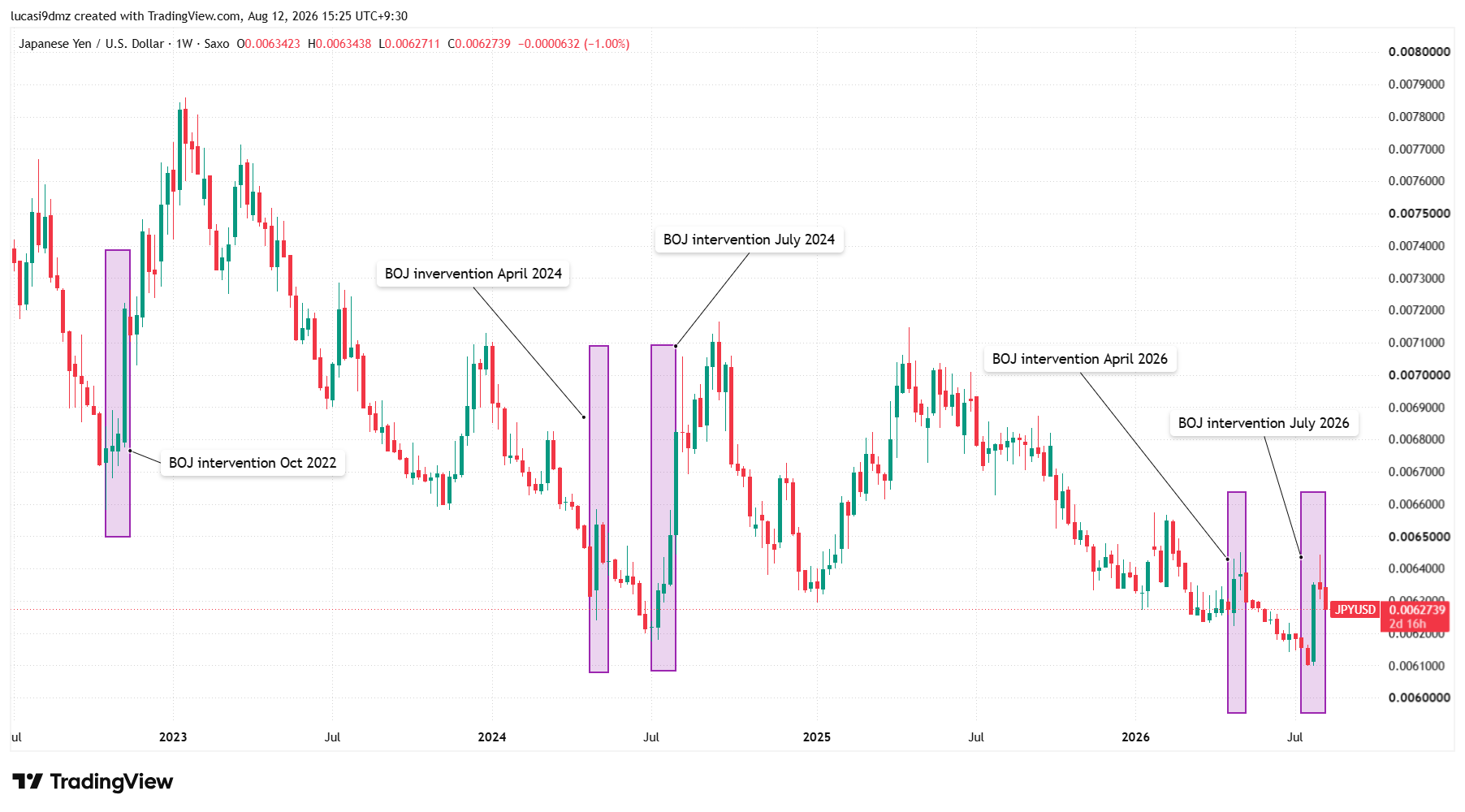
Bank of Japan yen intervention from August 2022 to August 2026 (JPYUSD)
Pressure on Treasuries.
To defend its currency, Japan would need to offload a significant volume of Treasuries. But this would flood a market already under pressure with extra supply. More supply typically means falling prices and rising yields.
Higher yields raise borrowing costs for the US government and tighten financial conditions everywhere. In other words, Japan's problem becomes America's problem too, giving the US a real incentive to keep Japan from becoming a forced seller. A distinct reversal of the old US mantra that “the dollar is our currency, but your problem”.
The US gets involved.
The US joined Japan in supporting the yen, an unusually hands-on move in currency markets. Rather than selling US dollars outright, the US sold euros to fund yen purchases.
Japan has indicated it plans to use the Federal Reserve's FIMA Repo Facility, which allows foreign authorities to obtain US dollars using their US Treasury holdings as collateral, rather than selling those bonds into the market. The facility was created during the 2020 pandemic to provide dollar liquidity when markets were under stress.
This gives Japan another source of dollars to defend the yen without having to sell Treasuries outright. In effect, the US is helping Japan defend its currency while trying to prevent that defence from becoming a problem for the US bond market.

The risk spreads to global markets.
Years of low interest rates in Japan allowed investors to borrow yen cheaply and invest the money in higher-yielding assets elsewhere (known as the carry trade). If the yen strengthens significantly, the currency cost of repaying those borrowings rises, reducing the appeal of the trade and potentially encouraging investors to unwind their positions.
The money borrowed in yen has been invested across global markets, including US technology stocks, emerging markets, corporate bonds and other risk assets. A sharp move in the yen would therefore force investors to sell assets across the board.
What happens next?
The risk is less a gradual yen recovery than the speed of the move. A sharp yen appreciation could trigger broader deleveraging and selling pressure across global markets. A sustained yen recovery would likely require a narrower Japan-US interest rate gap, through further BOJ hikes, lower US rates, or both. This makes the outlook for both central banks particularly important.
Intervention may support the yen in the near term, but a long-term recovery is far from certain. History shows that when markets lose confidence in a currency strategy, the eventual reversal can be abrupt, as seen when the Bank of England was forced to abandon its defence of sterling in 1992.
For investors, the key risk is the speed of any yen move: gradual strengthening may be manageable, while a sharp reversal could unsettle global markets.

References:
Why a Yen Reversal Could Shake Treasuries, Tech Stocks and Global Markets | Investing.com
https://www.federalreserve.gov/monetarypolicy/fima-repo-facility-faqs.htm
Federal Reserve Board - Federal Reserve announces establishment of a temporary FIMA Repo Facility to help support the smooth functioning of financial markets
https://www.ft.com/content/47d2ab3c-0423-49ed-89ca-68683761ed98
Time for an intervention | LSEG
Operation of monetary policy | Bank of England
This note is issued by Oakleigh Investment Management Pty Ltd ABN 59 640 392 516, Authorised Representative 1285 526 of Oakleigh Financial Services Pty Ltd AFSL 501454.
The above information are general thoughts only. It is not intended to be nor should it be taken to be financial advice. Because of that, before you make any financial decision, you need to have regard to your personal circumstances and also consider seeking professional advice.
This note contains general information only and is not intended to provide any person with financial advice. It does not take into account any person’s investment objectives, financial situation or needs. You should consider your personal situation and seek professional advice before making any financial decisions.
The note reflects Oakleigh Investment Management’s views and beliefs at the time of preparation which are subject to change without notice. The information is provided in good faith. No representations or warranties are made by Oakleigh Investment Management as to its accuracy and reliability. To the extent permitted by law, no liability is accepted by Oakleigh Investment Management for any loss or damage as a result of any reliance on this information.
Past performance is not a reliable indicator of future performance.
Please refer to full disclosures at www.oakleighfs.com/tcs.