
Are AI Companies in a Giant Race to the Bottom?
What’s the first thing that comes to mind when you think about the “AI technology revolution”?
Large hyperscalers? Applied AI leading to new medical breakthroughs? AI agents doing all your work for you, such as managing your diary, handling client relationships or booking your holidays?
Let us tell you what we think.
We think about… steam railroads.
Darren Wilson, Analyst, Oakleigh Investment Management
Tim Moffatt, Managing Director & Portfolio Manager, Oakleigh
Whilst the numbers regarding revenue and earnings growth these hyperscaler stocks have reported are simply incredible in some instances, regardless almost every AI stock price is now – falling! Albeit from very high prices.
Beyond the headlines, there is something fundamental about what’s going on that you need to understand.
We have entered a place where the narrative may be completely right, yet the stock prices of these companies may be completely wrong.
From an investment perspective, this equals risk.
And the explanation for this paradox is to be found in a long-forgotten boom almost two centuries ago.
The British Railway Mania
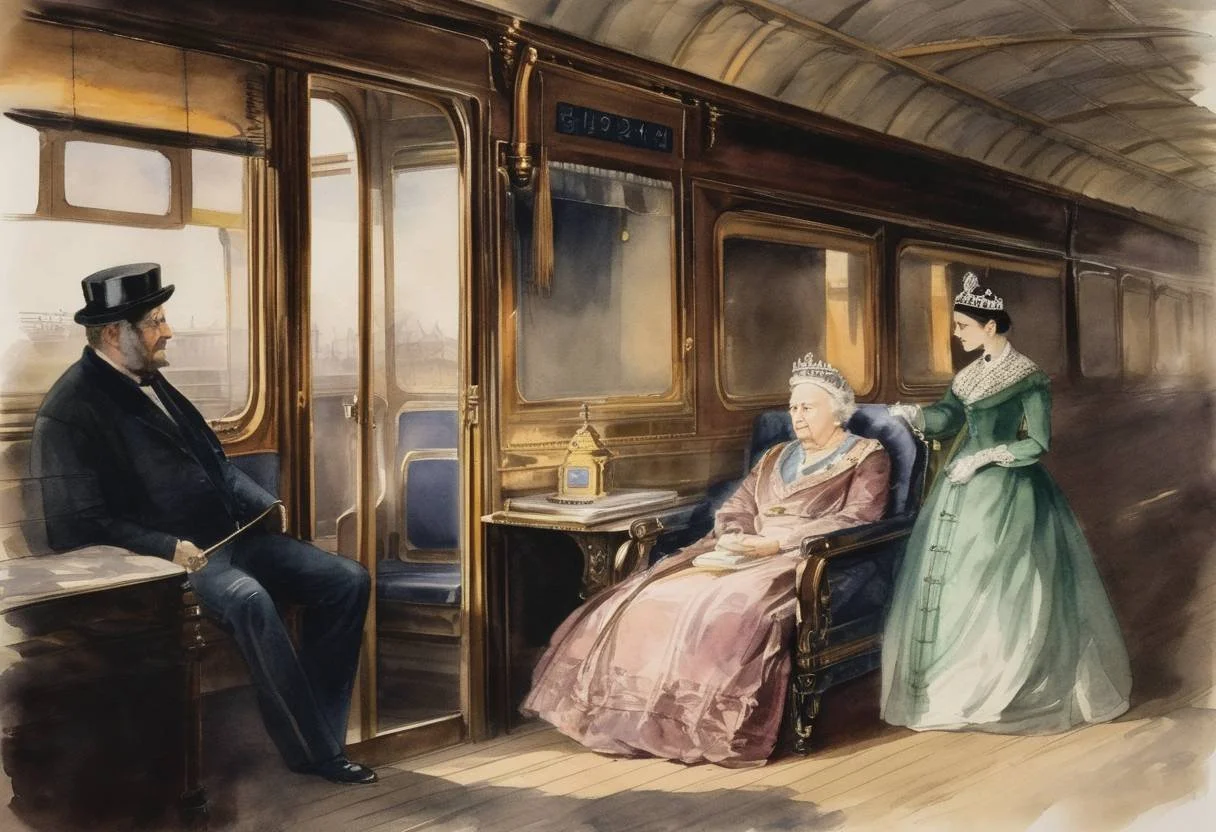
If we go back to the 1840’s, we find Britain coming out of recession. But those difficult times were quickly overshadowed by news about Queen Victoria taking her first ever train trip on June 13th, 1842, from Slough railway station just outside London, arriving at her destination 25 minutes later at Paddington station.
That 25-minute royal journey not only changed the prevailing attitude towards railways, but it also attracted private investors who were quick to seize upon the new popularity of the railways.
By the mid-1840s, improving economic conditions, lower interest rates and a
favourable
regulatory backdrop helped fuel a flood of new railway proposals
(assisted by the 1844 Railway Act and then the subsequent 1844 Bank Charter Act).
PICTURE REFERENCE: Queen Victoria’s First Train Ride, 1842: 25 Minutes to London
It was a classic elixir of improving economic conditions, investor enthusiasm for all things rail and now cheap money flooding the system, all the ingredients necessary for what is probably the biggest boom in history were there.
It came to be known as the ‘British Railway Mania’.
What really set things alight, was the fact most of these new rail companies were listed on the London Stock Exchange.
Everywhere you looked, official and unofficial publications were only talking about one thing, railway stocks and the incredible amount of money investors were making from them.
The demand to get in was so great that shares were denominated lower to allow the majority to buy. Many railway shares more than doubled as speculative enthusiasm swept across Britain.
Now, you might be thinking “Ah-ok, now I get the analogy. I see the relationship between that bubble in the 19th century and the AI bubble now”.
But that would be a mistake. Because whilst there are very strong parallels, it doesn’t address our core issue for today’s insight.
Why Record Profits Aren't Enough for AI Stocks.
Why, after posting record profits and revenue, are AI stock prices falling?
With the US 2nd quarter earnings season upon us, the truth now drops. And the truth – may hurt! Look at some of the biggest names in tech. Taiwanese Semiconductor Manufacturing Company ($TSMC) announced 2nd quarter revenue rose 36% to over $40 billion USD, posting its fifth straight record quarter. The effect? The stock price fell.
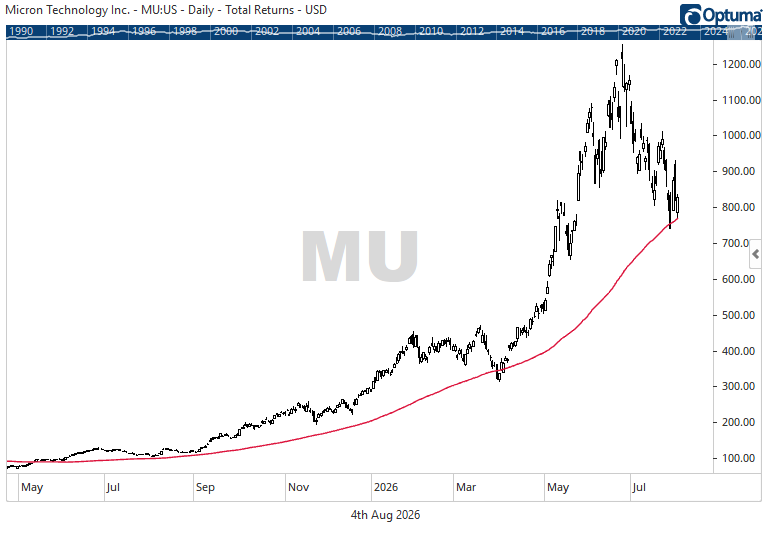
Micron Technology Inc - MU:US - Daily Total Returns USD
Micron ($MU) posted massive year-over-year revenue growth of roughly 345% to 346% in the fiscal third quarter of 2026.
Net income rose by an astonishing 1,400%. But the stock still sold off.
There have been plenty more related stocks behaving just like that since 2nd quarter earnings season began on July 14th, 2026.
So, what on earth is happening?
The answer may be a collective hallucination, akin to what brought down the British railway mania 180 years ago.
Britain's railway network expanded from a novelty in the 1830s to thousands of miles of track by the height of Railway Mania in 1846. Essential infrastructure that provided decades or centuries of economic benefit to English society.
Investors paid a premium to get involved in these railroad projects as the engineering costs were astronomical. And the formula used to anticipate potential returns were far too optimistic. But what really killed the bubble was simpler than that: overbuilding.
Far more track was laid than there was traffic to fill it. Once that surplus capacity was chasing the same passengers, competition drove fares down to basement levels, and the returns promised during the boom proved to be an illusion.
The cost cutting by railway operators got so bad that many railways offered free travel, hoping to make their money on the connecting rides from terminals. It was the dreaded race to the bottom.
And so, competition was ramping up when economic conditions inevitably started to worsen, when the revenue to pay dividends vaporised, and banks and lenders asked for their money back, the bubble finally burst for good.
A Race to the Bottom.

Is this where the AI tech boom ends up – a race to the bottom?
The competition is undercutting each other, and that competition is now more likely to come from China. China's Moonshot dropped Kimi K3 a few days ago (July 2026), a cheap open model, media desks are calling a "DeepSeek 2.0" moment.
And the fear it incites is simple: if good models get cheap, the trillions of dollars in buildout CAPEX gets harder to justify.
That lands hardest on the picks-and-shovels names in memory and AI hardware, where the spending must pay off for the investments to generate a sufficient return on capital.
Is the railroad mania the blueprint for the AI tech boom? And are we seeing the first signs that big money is asking itself the same question in the performance of those stock prices today?
PICTURE REFERENCE: What is China’s Kimi K3 and why is the US so rattled by it? | CNN Business
When the narrative may be completely right, the stock prices may be completely wrong.
It’s the reason why knowledge of history can provide you such a unique advantage when it comes to the markets. Reviewing previous historic bubbles, how they started, and especially how they end, can give you that priceless context and clarity to today’s events.
Now imagine being able to time all this before it happens? This focus on market cycles forms an important part of Oakleigh's investment process.
Semiconductors now represent some 20 percent of the entire S&P 500. One industry, one fifth of the American stock market. This is the highest weighting ever recorded, above even the dot-com peak.
Wall Street just raised its long-term earnings growth forecast for the S&P 500 to +25% a year, the highest ever recorded.
Analysts now assume chipmakers will keep 50 cents of every revenue dollar as profit, more than triple the market's margin.
The solution to high prices, is high prices.
All booms and bubbles eventually end, but market cycle dynamics endure.
An edge that Oakleigh uses to its fullest.
PICTURE REFERENCE: Traders work on the floor of the New York Stock Exchange. Photographer Michael Nagle/Bloomberg

References:
This note is issued by Oakleigh Investment Management Pty Ltd ABN 59 640 392 516, Authorised Representative 1285 526 of Oakleigh Financial Services Pty Ltd AFSL 501454.
The above information are general thoughts only. It is not intended to be nor should it be taken to be financial advice. Because of that, before you make any financial decision, you need to have regard to your personal circumstances and also consider seeking professional advice.
This note contains general information only and is not intended to provide any person with financial advice. It does not take into account any person’s investment objectives, financial situation or needs. You should consider your personal situation and seek professional advice before making any financial decisions.
The note reflects Oakleigh Investment Management’s views and beliefs at the time of preparation which are subject to change without notice. The information is provided in good faith. No representations or warranties are made by Oakleigh Investment Management as to its accuracy and reliability. To the extent permitted by law, no liability is accepted by Oakleigh Investment Management for any loss or damage as a result of any reliance on this information.
Please refer to full disclosures at www.oakleighfs.com/tcs.